Article from FHWA Innovator, Volume 7, Issue 40
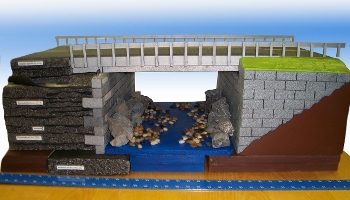
A tabletop model is showing Pennsylvania audiences how geosynthetic reinforced soils can improve the way bridges are built.
The geosynthetic reinforced soil integrated bridge system, a Federal Highway Administration Every Day Counts innovation, uses geosynthetic reinforcement and granular soils as a composite material to build abutments and approach embankments that are less likely to settle and create a bump at the end of the bridge. The GRS-IBS is easy to build and maintain and more cost-effective than conventional construction methods.
The Pennsylvania Department of Transportation, FHWA Pennsylvania Division and Pennsylvania State University combined forces to create the GRS model. Its main use is for training sessions on the technology, but it’s also making the rounds of transportation events and conferences throughout the state.
Built with lightweight materials, the model is easy to assemble and disassemble. When taken apart, it’s small enough to fit in a car. The model debuted at the September 2013 meeting of the Pennsylvania State Transportation Innovation Council before heading into a series of training sessions. It was also displayed at the Associated Pennsylvania Constructors Fall Seminar.
Designed and built by Steve Bloser and Eric Nevel at Penn State’s Larson Transportation Institute, the model clearly depicts the simple technology used in the geosynthetic reinforced soil bridge abutments, said Karyn Vandervoort, Every Day Counts coordinator for FHWA’s Pennsylvania Division.
“We are expecting more and more bridges to be constructed using this proven time- and cost-saving approach now that the visual tool is available for audiences across Pennsylvania,” she said.