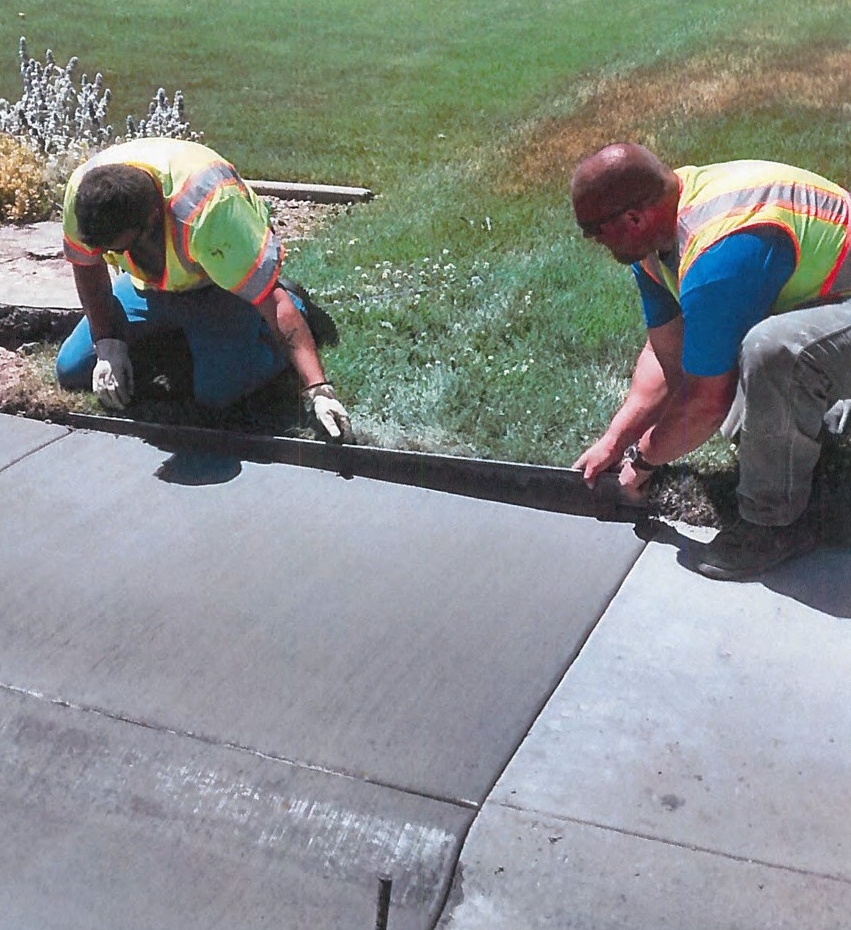
Ada County Highway District: Hurt Slip Form
Problem: Previously, when ACHD replaced sidewalk panels adjacent to lawn areas, we over-excavated and disturbed an area approximately one foot wide by the length of the sidewalk being replaced (10′-20′ typically). This often caused damage to sprinkler heads and lines as well as causing a need to replace topsoil and sod.
Solution: Bryant Hurt, an ACHD General Equipment Operator on the Cloverdale Grade Crew, developed a slip form to eliminate the need for over-excavation. The form is easily installed and removed with no need to intrude on property outside of the Right-of-Way. Eliminating the need to go back and repair sprinklers and lawn areas allows ACHD crews to move on to the next project while improving customer satisfaction by not disturbing people’s lawns and irrigation. This is critical during the hot summer months when ACHD receives numerous complaints about lawns dying due to lack of water and/or sprinklers on our sidewalk replacement projects.
Labor, Equipment, Materials: The initial prototype was cut out of wood as a template. A plasma cutter was then used to cut the final version from 1/4″ steel. The installation and removal tools were made from 1″ round stock steel.
Expenses: The initial creation costs were minimal (around $300) and Bryant invested approximately 20 hours of his time researching, developing, and fabricating the slip form and tools. Bryant created 20′ of slip form and one set of ergonomically friendly installation and removal tools.
Savings: The real savings result is not having to go back and repair sprinklers, topsoil, and sod. On a typical job, ACHD would save about five hours with two employees, a pickup truck, and any necessary materials. The resulting amount saved is approximately $600 for a 10′-20′ long section of repair. In 2015, ACHD removed and replaced approximately 3,400 LF of sidewalk. If each project averaged 20 LF and had the sprinklers and lawn repaired, Bryant’s slip form could have saved around $102,000 in labor and materials. (3400’/20′ = 170 x $600 = $102,000)