2019 Spotlight Award
Bonner County Road and Bridge: Locally Funded Improvements
- Problem Statement: As with all road jurisdictions in Idaho, there is a shortage of funding to improve roads and always a high volume of demands for improvements from vocal residents who believe that their road deserves special consideration and priority for improvements. These vocal residents sometimes band together into groups and petition their elected officials for consideration. In order to establish a methodology for dealing with these issues, Bonner County has begun a Locally Funded Improvement program (LFI) and adopted those guidelines and procedures as part of the Bonner County Roads Standards Manual (BCRSM).
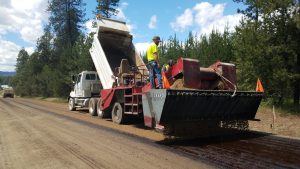
- Summary of Solution: Under the guidelines set forth in the BCRSM, residents who desire to have improvements made to their road (typically they desire an upgrade from gravel to hard surfacing) may petition to Board of County Commissioners to participate in a LFI project wherein the residents would raise money for the majority of materials or contractor costs and Bonner County would participate by supplying the labor and equipment in order to place a BST or asphalt surface. The program is completely voluntary, with no requirement for any citizens to participate, which makes it drastically different from an LID (Local Improvement District) which is compulsory and assessed using taxes. This public-private partnership has proved effective in making projects financially feasible for Bonner County to accomplish the work and improve additional miles of the overall system. The BCRSM Version 2 with the LFI section was adopted by the Board of Commissioners in December 2017. This language has proved to be very effective in conversations with vocal groups, as we are able to outline how they might participate in order to accomplish the projects for which they rally. It also allows us to show all of these groups the same standards, and to uphold those standards between changes in the political scene. Since adoption of the program, we have successfully completed one LFI project in 2018 which placed 0.7 miles of BST on a gravel road (Spring Haven Dr & Merritt Lane) through a neighborhood. Now in 2019 we have another 3-mile BST project about to happen for which residents have contributed $100,000 in order to make possible (Wooded Acres Rd). This project has sparked newspaper articles about the process, which has led to a flurry of other interested groups showing interest in additional projects in 2020 and beyond.
- Labor, Equipment, Materials: Materials is typically gravel, liquid asphalt oils, and chips, and/or hot mix asphalt. Labor & Equipment are Bonner County crews and typical road building equipment.
- Expenses: Varies per project. Residents are typically contributing around 50-65% of the total project cost.
- Savings/Benefit: Bonner County currently has in the neighborhood of 400 miles of gravel roads that we maintain. Expansion of the hard surface road network is an expensive and slow process, usually relying on grant money in order to make improvements. This program offers up another avenue to expand the hard surfacing into those vocal areas which are of high importance to local residents but which would still be many decades out as the County pours its limited funds into maintenance of the arterial and collectors. Every expansion of the hard surface network is a benefit to the overall system and all who use it. Reduction of dust improves the quality of life of everyone around. Hard surfacing requires fewer hours of maintenance, increases traction in dry, wet, and snow conditions, and is a smoother ride. This voluntary partnership is improving the road network in a new way, a little bit at a time, by making more projects financially feasible.